
Case Study CS05 · Fine-gauge Merino
16GG Merino Wool Rib Cardigan Development
Reviewed by VIAKNIT Technical Development Team
Balance rib definition, neckline construction and fit in a lightweight cardigan.
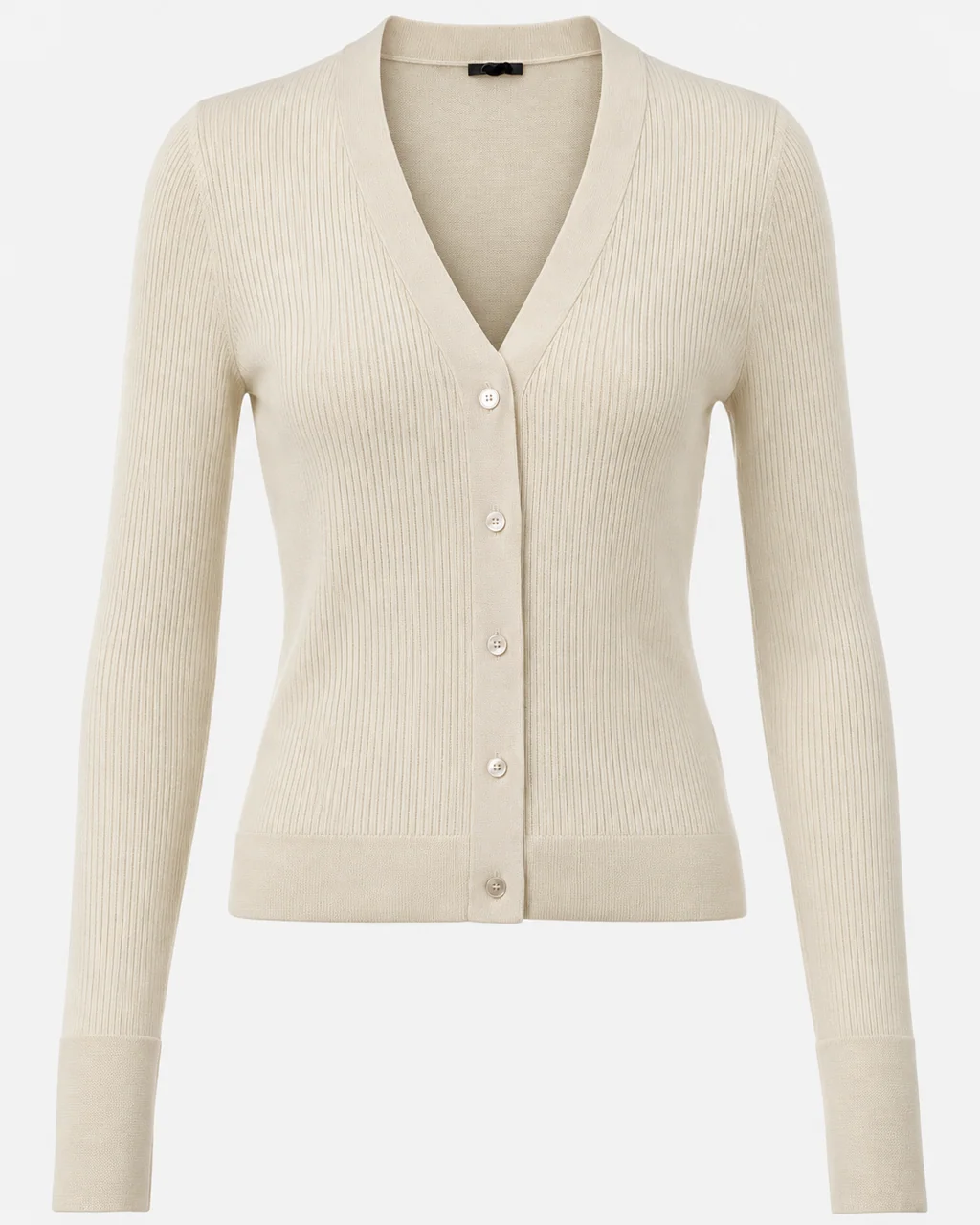
A fine-gauge Merino wool cardigan may look simple, but achieving the right balance of softness, rib definition, fit and dimensional stability requires careful technical development.
This VIAKNIT case study focuses on a women's V-neck cardigan developed in 100% Merino wool, using 2/60NM yarn and a 16GG knitting construction. The design features a refined 2×1 rib structure, an ivory-white colour, a full button front and a fitted silhouette.
The main development challenge was to translate a relatively simple design into a well-balanced knitted garment. The fine yarn and rib construction needed to work together to achieve a soft hand feel and clearly defined vertical texture, while the garment measurements had to account for the natural elasticity of rib knitting.
Particular attention was also given to the V-neck, front placket, button positioning, cuffs and hem, as these details can influence the appearance and dimensional stability of a fine-gauge cardigan.
At VIAKNIT, we approach this type of project through coordinated yarn evaluation, rib structure development, garment measurement review and sample refinement before preparing the specifications for bulk production.
Project Background: A Refined Fine-Gauge Women's Cardigan
The project involved developing a classic women's V-neck cardigan for the European fashion market.
Rather than relying on complex prints or decorative elements, the design uses a clean silhouette, a soft ivory-white colour and a defined knitted texture to create a refined appearance.
The designer wanted a cardigan that could be worn independently as a lightweight knitwear piece or layered over other garments for everyday styling.
After reviewing the reference images and initial measurement information, the development focused on two main requirements.
The first was to preserve the fitted and understated feminine silhouette.
The second was to replace the conventional plain jersey body with a more distinctive 2×1 rib construction, creating a continuous vertical texture across the garment.
Although the design appears relatively straightforward, fine-gauge rib knitwear requires careful coordination between yarn characteristics, stitch density and garment measurements.
The elasticity of rib construction means that standard jersey measurement assumptions cannot simply be applied to the finished cardigan.
Product Specifications and Design Requirements
The development specifications were established as follows.
| Specification | Project Details |
|---|---|
| Product | Women's V-Neck Cardigan |
| Fibre Composition | 100% Merino Wool |
| Yarn Count | 2/60NM |
| Machine Gauge | 16GG |
| Main Stitch Construction | 2×1 Rib |
| Main Colour | Ivory / Off White |
| Neckline | V-Neck |
| Front Opening | Full Button Front |
| Buttons | 4 Pieces |
| Cuffs | Ribbed Finishing |
| Hem | Ribbed Finishing |
| Size Range | XS / OKS / M / L |
The customer provided a garment measurement chart covering shoulder width, chest, hem, sleeve length, sleeve width, cuff, neckline and front placket measurements.
Rather than estimating dimensions from reference images, VIAKNIT used the supplied measurement chart as the starting point for garment development.
This is particularly important for a fitted 2×1 rib cardigan.
Rib structures have pronounced crosswise elasticity, and the finished garment measurements need to be considered in relation to the fabric's natural stretch and recovery.
A measurement that works for a plain jersey cardigan may not produce the same fit when applied to a 2×1 rib construction.
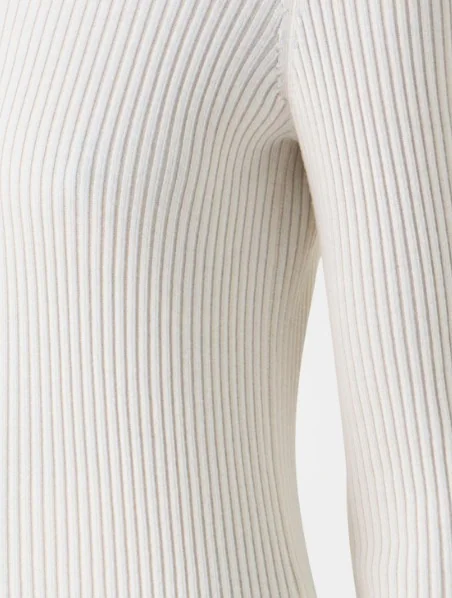
Six Technical Challenges in Fine-Gauge Rib Cardigan Development
3.1 Balancing Softness and Rib Definition in 16GG Construction
The first challenge was to achieve a soft fabric hand feel without losing the definition of the 2×1 rib structure.
16GG is a fine knitting gauge, while 2/60NM Merino wool is a relatively fine yarn specification.
If the stitch density is too tight, the fabric may become firm and lose some of the softness expected from Merino wool.
If the construction is too loose, the rib columns may become less defined and the fabric may be more susceptible to losing its intended shape during wear.
Our development approach is to produce representative 2×1 rib swatches and compare different stitch lengths, yarn tension settings and finishing conditions.
The swatches should be evaluated for softness, thickness, rib definition and overall fabric appearance.
Importantly, the machine-off condition is not sufficient for making the final decision. The finished and relaxed swatch provides a more useful reference for assessing the actual fabric characteristics.
3.2 Managing the Fitted Silhouette Around Rib Elasticity
The cardigan uses a fitted silhouette with different measurement requirements across the chest, waist and hem.
A 2×1 rib structure provides considerable crosswise elasticity, but the actual stretch behaviour can vary depending on the fabric construction and the area being evaluated.
The challenge is to achieve a close-fitting garment without creating excessive tension around the chest or unnatural horizontal creasing around the waist.
Our development approach focuses on the relationship between rib density and finished measurements at the chest, waist and hem.
The garment should be reviewed both on a mannequin and through a practical fitting assessment.
Static measurements alone cannot fully explain how a ribbed cardigan behaves when worn.
The fit review should also consider movement, fabric extension and how the rib structure returns after being stretched.
3.3 Controlling Tension and Dimensional Stability in 100% Merino Wool
Merino wool is valued for its natural softness, elasticity and comfortable hand feel.
However, the final dimensions of a Merino wool garment are influenced by yarn characteristics, knitting tension and finishing conditions.
If bulk garment measurements are confirmed directly from freshly knitted dimensions, subsequent finishing may introduce dimensional differences.
During development, yarn, knitted swatch and garment finishing records should therefore be retained.
Measurements before and after finishing should be compared, with particular attention to body length, chest width, sleeve length and hem width.
The purpose is to establish a reliable finished measurement reference for subsequent production.
For fine-gauge wool knitwear, this step is important because even relatively small dimensional changes can affect the appearance of a fitted cardigan.
3.4 Maintaining V-Neck and Front Placket Stability
The V-neck and front placket are important structural areas of this cardigan.
Unlike a pullover, a full-button cardigan has an opening that needs to maintain its shape while supporting the weight and tension created by the buttons and front edges.
If the placket construction is too soft or stretches excessively, the front may develop waviness, curling or uneven button alignment.
Our development approach is to review the symmetry of both sides of the V-neck, the neckline connection, placket width and button spacing.
The elasticity of the placket also needs to be considered in relation to the main 2×1 rib fabric.
Where necessary, alternative placket constructions, stabilising tapes or reinforcement methods can be evaluated during sample development.
The final approach should be confirmed through the actual garment construction rather than assumed from the design drawing.
3.5 Coordinating Cuffs and Other Finishing Structures with the Main Rib Fabric
The main body uses a 2×1 rib structure, while the cuffs, neckline edges and front finishing require coordinated construction.
If the density and tension of different knitted sections are not properly balanced, the garment may develop overly tight cuffs, uneven sleeve transitions or inconsistent finishing thickness.
Our development approach is to evaluate the main rib fabric and the relevant finishing structures through separate representative swatches.
Particular attention should be given to the transition between the sleeve and cuff, the elasticity of the cuff and the flatness of the finished edges.
For a fitted cardigan, the cuffs should retain their intended shape after repeated dressing and removal.
The relationship between the main fabric and finishing structures is therefore an important part of the overall garment development.
3.6 Maintaining Consistent Colour, Measurements and Hand Feel in Bulk Production
An approved sample does not automatically guarantee that every subsequent garment will have identical characteristics.
For 100% Merino wool knitwear, yarn batches, machine settings, finishing conditions and production methods can all influence the finished appearance.
Before bulk production, an approved sample and technical specification file should be established.
The production references should include yarn batch information, colour references, 2×1 rib construction, garment measurement standards and finishing requirements.
During production, the main inspection points include rib definition, consistency between front and back panels, left and right sleeve appearance, placket flatness, button positioning, stitch defects and finished garment measurements.
Maintaining these references helps the production team work towards the same approved standard throughout the order.
VIAKNIT's Development Process: From First Sample to Bulk Production Preparation
For fine-gauge Merino wool cardigans, we organise development into six stages.
Stage 1 — Tech Pack Review
Review the design images, garment measurement chart, 2/60NM yarn specification and 16GG knitting requirements.
The objective is to confirm that the technical information is sufficiently complete for the first development stage.
Particular attention should be given to the relationship between the specified garment measurements and the intended 2×1 rib construction.
Stage 2 — Yarn and Swatch Development
Confirm the 100% Merino wool yarn and develop representative 2×1 rib swatches.
Different stitch densities and fabric hand feels can be compared to establish the preferred construction.
The swatches should be assessed after the relevant relaxation and finishing conditions.
Stage 3 — First Garment Prototype
Develop the first complete cardigan.
The main review areas include V-neck proportions, chest and waist measurements, sleeve length and the overall fitted silhouette.
The front placket and button positions should also be examined as part of the complete garment construction.
Stage 4 — Fit and Construction Adjustment
Review the first sample through garment measurement and fitting assessments.
Where necessary, adjustments can be made to garment dimensions, front placket construction, cuffs and finishing details.
The objective is to improve the relationship between the knitted fabric behaviour and the intended garment fit.
Stage 5 — Pre-Production Sample
Prepare the PP sample using the confirmed yarn, knitting structure and finishing specifications.
The pre-production sample should provide the reference for the intended bulk manufacturing process.
The relevant colour, measurement and construction details should be reviewed before approval.
Stage 6 — Bulk Production and Quality Control
Once the PP sample and technical specifications have been approved, the production team can proceed using the confirmed manufacturing references.
Quality control should cover garment measurements, knitted appearance, linking, buttons, finishing and overall presentation.
This creates a clearer connection between the original design requirements, sample development and subsequent production.
VIAKNIT's Key Technical Decisions
Three technical decisions are particularly important in this development.
Why Use 16GG Fine-Gauge Knitting?
16GG provides a fine knitted surface suitable for refined women's knitwear.
For this cardigan, the gauge supports the intended lightweight and understated appearance while allowing the vertical rib texture to remain an important design feature.
However, gauge alone does not determine the final fabric weight or softness. Yarn count, stitch length, density and finishing conditions all influence the finished result.
Why Choose 2×1 Rib Instead of Conventional Jersey?
Compared with plain jersey, 2×1 rib creates a more pronounced vertical texture and generally provides greater crosswise elasticity.
This construction is more consistent with the fitted design direction of the cardigan.
The actual stretch and recovery still depend on the yarn, knitting settings and finished fabric characteristics.
Why Use 2/60NM 100% Merino Wool?
The specified 2/60NM Merino wool yarn provides a development direction suited to fine-gauge, lightweight and soft knitwear.
Its fibre composition and yarn specification are important starting points for achieving the intended product character.
The final fabric weight, hand feel and drape should nevertheless be confirmed through actual knitted swatches.
Quality Assessment and Technical Verification
Before approving the final sample, the cardigan should be assessed against its design and technical specifications.
| Inspection Area | Main Evaluation Criteria |
|---|---|
| Knitting Structure | Clear and consistent 2×1 rib texture |
| Yarn Composition | 100% Merino Wool |
| Machine Gauge | 16GG |
| Dimensional Stability | Measurements before and after washing |
| Elastic Recovery | Rib fabric extension and recovery |
| Pilling | Surface appearance under the agreed testing method |
| Linking | Shoulder, sleeve and side-seam construction |
| Final Appearance | Placket, neckline, cuffs and overall garment presentation |
For this type of wool cardigan, dimensional stability should be assessed after the relevant relaxation and finishing processes.
Rib fabric behaviour is influenced by the interaction between yarn characteristics, stitch construction and finishing history.
The finished garment should therefore be evaluated using the agreed measurement method and actual sample condition.
The objective is to establish clear acceptance criteria for the final PP sample rather than relying only on the appearance of the first knitted prototype.
What Designers Should Consider Before Developing a 16GG Rib Cardigan
A fine-gauge rib cardigan requires careful coordination between the yarn, knitted structure and garment measurement specifications.
Before starting development, designers should consider the intended fit, yarn composition, yarn count, knitting gauge, rib construction and finished garment dimensions.
For a 2×1 rib cardigan, the measurement chart should take account of the natural elasticity of the fabric.
The V-neck and front placket should also be identified as separate construction considerations because their stability can influence the overall appearance of the garment.
If the project begins with a reference image rather than a complete Tech Pack, the development process can start with a technical review and measurement discussion.
Representative swatches can then be developed to establish the preferred fabric construction before proceeding to a complete garment sample.
For designers developing lightweight Merino wool knitwear, confirming the finished fabric behaviour early can help reduce unnecessary revisions during garment sampling.
Technical Questions
What is the difference between 14GG and 16GG ribbed cardigans?
14GG and 16GG refer to different knitting machine gauges.
16GG has a finer needle arrangement than 14GG and can support a more refined knitted surface when the yarn and construction are suitable.
However, a higher gauge does not automatically produce a lighter or softer garment. Yarn count, stitch density, rib construction and finishing conditions also influence the final result.
How do you control the stretch and recovery of fine-gauge ribbing?
Stretch and recovery are influenced by yarn characteristics, stitch length, knitting tension, rib construction and finishing.
During development, representative rib swatches can be compared for horizontal extension and recovery after stretching.
The actual finished fabric should be evaluated rather than relying only on the theoretical elasticity of the rib structure.
What should buyers check when approving a 16GG cardigan sample?
Buyers should review the yarn composition, knitting gauge, rib definition, fabric hand feel and garment measurements.
For a V-neck cardigan, the neckline symmetry, front placket stability, button positioning, cuffs and overall garment proportions also require attention.
Dimensional stability, stretch recovery and surface appearance should be evaluated according to the agreed product specifications.
The approved PP sample should then serve as the reference for bulk production.
Related Expertise
14GG Ribbed Knit Maxi Dress Development ↗
Discuss Your Project