
Case Study CS01 · 14GG colourwork
14GG Ski-Themed Intarsia Sweater Development
Reviewed by VIAKNIT Technical Development Team
Translate a ski illustration into readable colour blocks and raised loop details at 14GG.
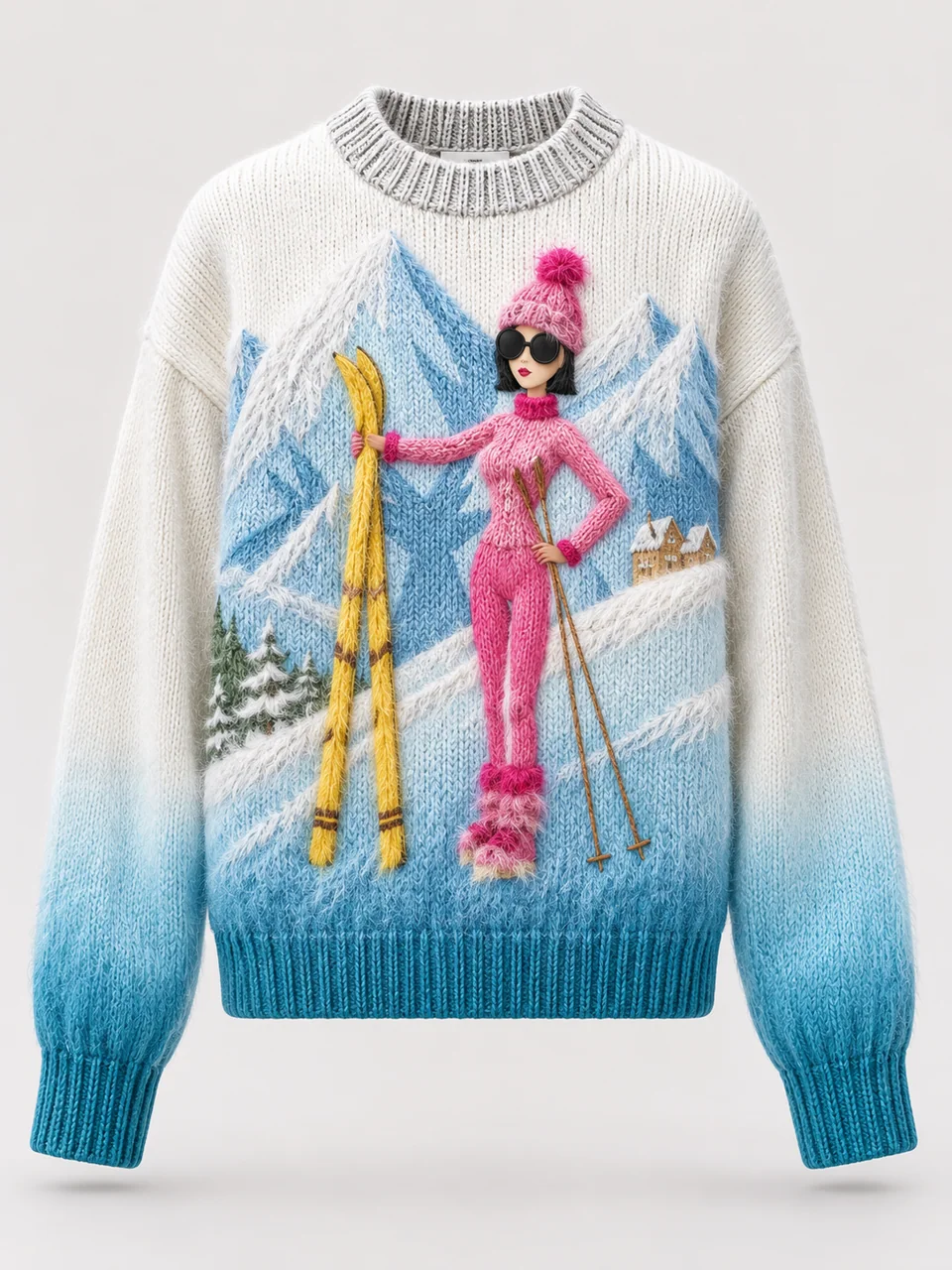
A ski-themed sweater developed for an independent design team, combining multi-colour intarsia, jacquard construction, loop stitch details and specialty yarns within a fine-gauge knitted garment.
The design features a winter ski scene with blue and white mountain landscapes, a female skier in pink, yellow skis and raised decorative details. Rather than reproducing the artwork as a printed image, the objective was to translate its visual elements into knitted structures and dimensional textile details.
The main development challenge was to balance artwork definition, colour separation, yarn compatibility and garment construction while keeping the design suitable for machine knitting.
At VIAKNIT, this type of project involves more than following an artwork file. It requires technical decisions about stitch construction, knitting programming, yarn selection, special techniques and garment development.
Project Background
The project involved a women's creative knitwear design intended for the European and North American fashion markets.
The designer wanted to create a distinctive winter scene on a soft white knitted sweater. The main visual elements included a female skier wearing pink, yellow ski equipment, blue mountain scenery and raised decorative details around the character.
Several knitting and embellishment techniques were required to achieve the intended appearance.
The initial technical assessment focused on identifying which elements could be produced directly through machine knitting and which required separate yarn or additional decorative techniques.
This distinction was important because intarsia, jacquard and loop stitch construction have different technical characteristics. Choosing the wrong approach could affect artwork definition, fabric thickness, flexibility and the appearance of the finished garment.
Design Requirements and Yarn Specifications
The development was based on the following technical specifications.
| Specification | Project Details |
|---|---|
| Main Yarn | ATHENA 2/68 NM |
| Main Yarn Composition | 62% Viscose / 38% PBT |
| Secondary Yarn | EMPIRE 2/60 NM |
| Secondary Yarn Composition | 100% Merino Wool |
| Special Yarn | Loop / Specialty Yarn |
| Main Colour | Soft White |
| Artwork Colours | Blue, Light Blue, Royal Blue, Hot Pink, Yellow and Black |
| Main Construction | Intarsia + Jacquard |
| Special Technique | Loop Stitch |
| Sample Size | S |
| Size Range | XS–L |
The two main yarns serve different development purposes.
The viscose and PBT blended yarn provides the main fabric base. Its softness, elasticity, stitch formation and appearance around the multi-colour artwork are important considerations.
The 100% Merino wool yarn introduces a different fibre composition and fabric character. Its compatibility with the main yarn needs to be considered in terms of yarn thickness, knitting tension, surface appearance and finishing behaviour.
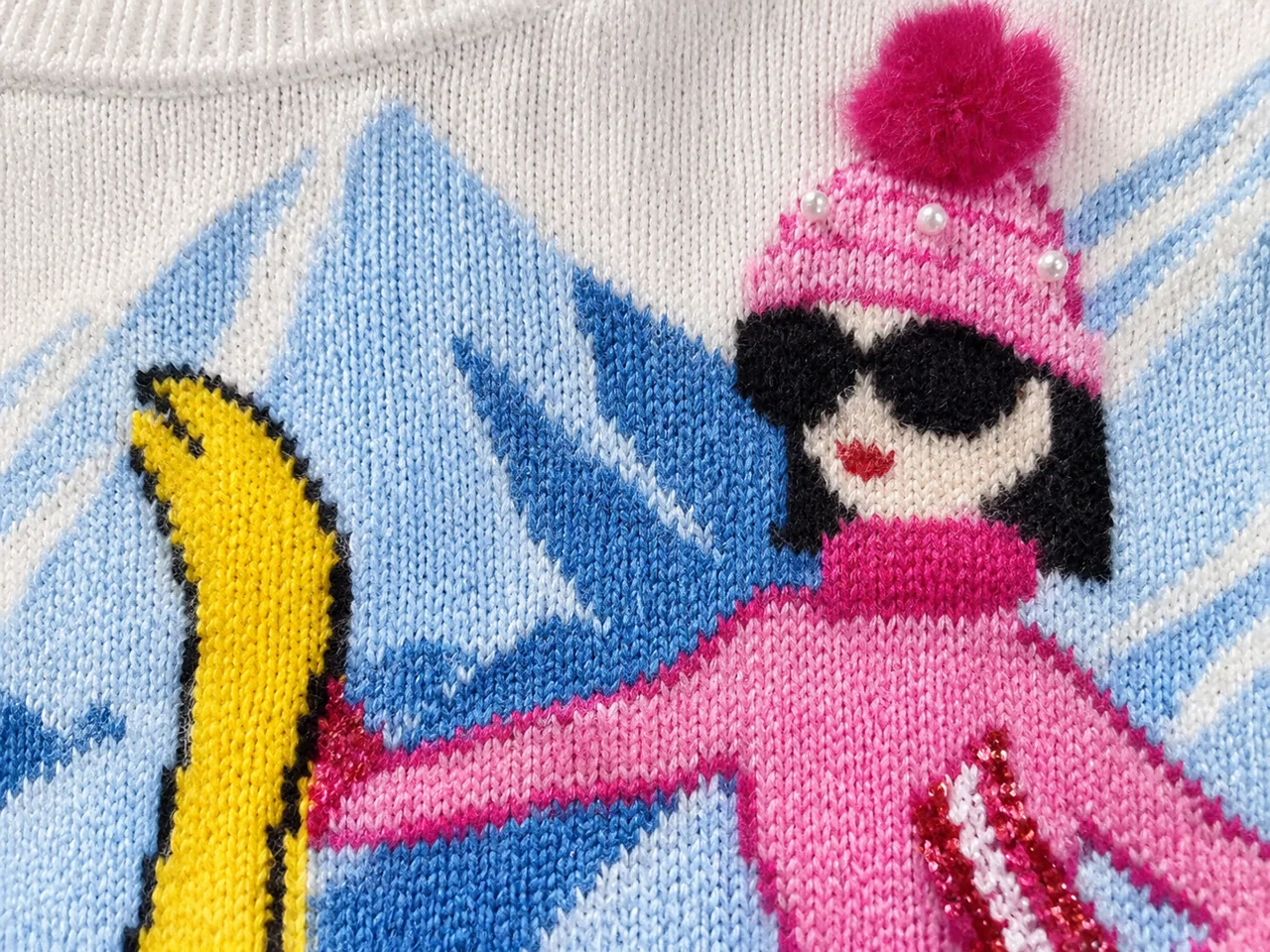
The specialty yarn is used for raised decorative effects, including the fluffy details around the skier's hat.
When combining different yarn constructions on a 14GG knitting machine, the same knitting settings cannot automatically be applied to every material. Yarn behaviour must be evaluated through appropriate swatch development before the complete garment is finalised.
Six Technical Challenges in Development
3.1 Converting Complex Artwork into Machine-Knitted Patterns
The original illustration contained several visual elements, including the skier, skis, mountains, trees and multiple colour areas.
A digital illustration can contain fine lines and small details that are difficult to reproduce accurately within individual knitted stitches.
The first technical task was to divide the artwork into workable colour areas and adapt the important outlines to the 14GG knitting structure.
Particular attention was required around the skier's black goggles, the yellow ski edges and the pink clothing outlines.
If a line is too narrow, it may not be clearly represented by the available stitch width. Excessive small colour sections can also increase yarn changes and programming complexity.
The objective was therefore not to reproduce every pixel of the original artwork. It was to retain the recognisable design elements while adapting the illustration to a practical knitting structure.
3.2 Managing Intarsia Colour Transitions and Reverse-Side Yarn Connections
Multi-colour intarsia was one of the central technical considerations in this project.
Intarsia uses separate yarn feeds for different colour areas rather than carrying long unused floats across the back of the fabric. The yarn connections between adjoining colour sections therefore require careful attention.
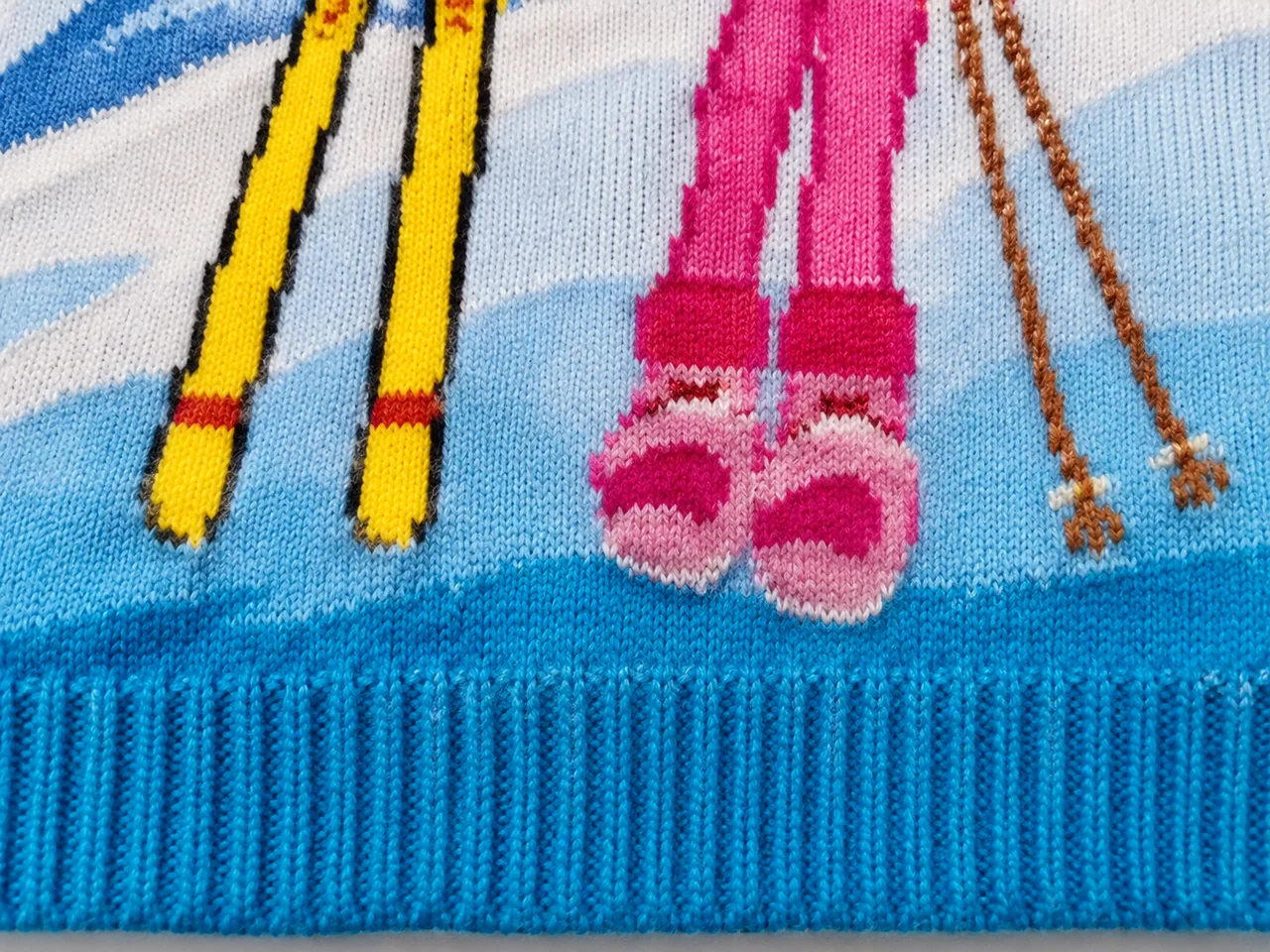
For this ski-themed design, the main inspection points included the transitions between blue and white mountain sections, the continuity of the pink skier's outline and the definition of the yellow ski edges.
The connection points also needed to be checked for unwanted openings, missed stitches and loose yarn ends.
Knitting programming and yarn securing methods both influence the appearance and durability of these areas.
On complex graphic knitwear, the front appearance alone is not enough to assess construction quality. The reverse side also needs to be examined to understand how the different colour sections are connected and secured.
3.3 Creating Raised Loop Stitch and Fluffy Decorative Details
The raised details give this sweater a different visual character from a conventional graphic intarsia garment.
The skier's hat includes a fluffy pom-pom effect, while selected decorative areas require additional surface texture.
A standard flat-knit surface would not create the same dimensional appearance.
The loop stitch areas therefore require separate development attention, particularly in relation to specialty yarn selection, loop height, density and attachment security.
The important considerations include how the decorative yarn interacts with the surrounding fabric, whether the reverse-side construction provides adequate security and whether the raised details retain their intended appearance after finishing.
The hat pom-pom also needs to be considered beyond its appearance immediately after knitting. Packaging, transportation and normal wear can compress raised decorative elements.
For this reason, dimensional appearance and attachment security should be considered together during development.
3.4 Coordinating Different Yarns on a 14GG Knitting Machine
The garment combines a viscose and PBT blend, 100% Merino wool and specialty loop yarn.
These materials differ in fibre composition, yarn construction, elasticity and knitting behaviour.
Using identical tension settings across all three materials may result in inconsistent stitch formation, uneven fabric surfaces or excessive thickness in decorative areas.
Our technical approach is to evaluate each material separately before considering how the different yarns work together within the garment.
The main areas for comparison include fabric thickness, surface level, the transition between the Merino wool and blended yarn sections, the influence of specialty yarn on surrounding stitches and potential differences in dimensional change after finishing.
The purpose is to achieve a coordinated fabric appearance rather than treating each yarn as an independent component.
3.5 Maintaining Artwork Position and Garment Proportions Across Sizes
The skier is the visual focal point of the garment.
Even relatively small changes in artwork placement can affect the overall balance of the design, particularly around the shoulders, sleeves and lower body.
The knitting programme therefore needs to take account of the character's centre line, artwork height and horizontal positioning.
The initial sample size is S, while the intended size range is XS–L.
Artwork placement should not simply be enlarged or reduced in direct proportion to garment measurements. The visual relationship between the skier and the garment needs to remain appropriate across the different sizes.
This requires consideration of garment dimensions and artwork positioning together during size development.
3.6 Preparing Complex Knitwear for Consistent Bulk Production
A complex knitted sample can look convincing, but the same appearance must also be reproducible under the intended production conditions.
For this type of garment, important control points include loop height, decorative yarn attachment, colour consistency and the accuracy of intarsia connections.
A practical production reference should identify the approved knitted swatch, artwork and knitting programme, yarn specifications and colours, loop stitch requirements and the approved pre-production sample.
These references help ensure that the production team works to the same technical and visual standards.
For VIAKNIT, the objective is to consider production requirements during development rather than leaving them until after the sample has been completed.
VIAKNIT's Development Process
The development approach can be organised into four stages.
Stage 1 — Artwork Assessment and Knitting Programming
The skier, mountain scenery and ski equipment are separated into suitable knitted colour areas.
The artwork is then adapted to the 14GG knitting structure, with particular attention to the size and definition of small details and the connection between different colour sections.
Stage 2 — Knitdown and Yarn Development
The main blended yarn, Merino wool and specialty yarn are evaluated for their individual knitting characteristics.
The development focus includes stitch formation, fabric appearance, colour coordination, thickness and the raised loop effect.
Stage 3 — First Garment Sample
The complete sweater is developed in size S.
The main review areas include the definition of the skier, artwork proportions, raised decorative details, neckline, cuffs and hem construction.
Stage 4 — Fit Review and Pre-Production Approval
The garment is reviewed against the intended design and technical requirements.
Any required adjustments to artwork placement, garment dimensions or local construction details are considered before the relevant sample and production specifications are approved.
The knitting programme and quality references can then be controlled against the approved development version.
Key Technical Decisions
The 14GG gauge was selected as the main knitting foundation to balance graphic detail, fabric thickness and wearing comfort.
The colour arrangement also plays an important role in maintaining the visual hierarchy of the design.
Soft white provides the main winter background. Blue and light blue establish the mountain scenery, while the pink skier becomes the visual focal point. Yellow creates a clear contrast through the ski equipment, and black is used for selected outlines and small details.
The garment construction includes a 1×1 rib neckline and 2×1 rib cuffs and hem.
These details help maintain a consistent appearance across the garment while allowing the graphic elements to remain the main design feature.
The final fabric density, loop stitch parameters and finishing conditions must be determined through the relevant technical development and swatch assessment rather than assumed from gauge alone.
Quality Assessment and Verification Points
For a complex graphic sweater, quality assessment should cover both the visual result and the underlying knitted construction.
The following inspection points are relevant to this project.
| Inspection Area | Main Technical Considerations |
|---|---|
| Artwork Accuracy | Skier definition, mountain outlines and artwork positioning |
| Intarsia Connections | Colour transitions, missed stitches and openings |
| Yarn Security | Yarn connections and secured ends |
| Loop Stitch Details | Loop height, density and attachment security |
| Colour Consistency | Colour matching across the different yarn areas |
| Dimensional Stability | Garment measurements before and after washing |
| Pilling | Surface condition after appropriate wear or testing evaluation |
| Overall Appearance | Balance between graphic elements, texture and garment construction |
Merino wool also requires appropriate consideration during washing and finishing, particularly in relation to potential felting, dimensional changes and surface appearance.
These are quality assessment requirements, not a claim that every test has already been completed or that specific test results have been obtained for this project.
The final acceptance criteria should be agreed according to the garment specification and the customer's requirements.
Technical Lessons for Fashion Designers
Complex graphic knitwear requires decisions to be made at both the artwork and fabric construction levels.
A design that works well as a digital illustration may need adjustments before it can be translated into a knitted structure. Fine lines, small colour sections and raised details all need to be evaluated in relation to the selected gauge and yarn.
The choice between intarsia and jacquard should also be based on the actual artwork and the required fabric characteristics, rather than colour count alone.
When different yarn compositions are combined, their knitting and finishing behaviour should be assessed individually and as part of the complete construction.
For designers developing similar products, it is useful to provide the original artwork, preferred yarn direction, garment references, size range and target production quantity at the beginning of the project.
This gives the technical team a clearer basis for evaluating construction options and identifying potential development challenges before full garment sampling.
Technical Questions
What is the difference between intarsia and jacquard knitting?
Intarsia and jacquard are both used to create multi-colour knitted designs, but they use different knitting constructions.
Intarsia uses separate yarn feeds for individual colour areas and is particularly suitable for certain larger graphic shapes and clearly defined colour sections.
Jacquard uses a programmed stitch structure to produce colour patterns. Depending on the jacquard construction, the reverse side, fabric thickness, yarn consumption and stretch characteristics can differ.
The appropriate technique depends on the artwork, colour distribution, fabric requirements and intended garment appearance.
How do you reduce holes and uneven connections between intarsia colour areas?
The main considerations include colour-area connections, yarn feed movements, stitch formation and yarn-end securing methods.
The technical team needs to examine the transition between adjoining colour sections and check whether openings, missed stitches or loose connections are present.
Both the front and reverse sides should be inspected during sample development.
Can loop stitch and specialty yarn details be incorporated into fine-gauge knitwear?
Yes, subject to the design, yarn characteristics and machine capabilities.
The main considerations include yarn thickness, loop height, density, attachment security and the relationship between the raised details and the surrounding knitted fabric.
For decorative areas such as fluffy pom-poms, the intended appearance should also be considered in relation to finishing, packaging and handling.
Related Expertise
7GG Wool Fair Isle Sweater Development ↗
Discuss Your Project