Jacquard Knit
Programmed colour selection builds motifs into the fabric.
Technical Overview
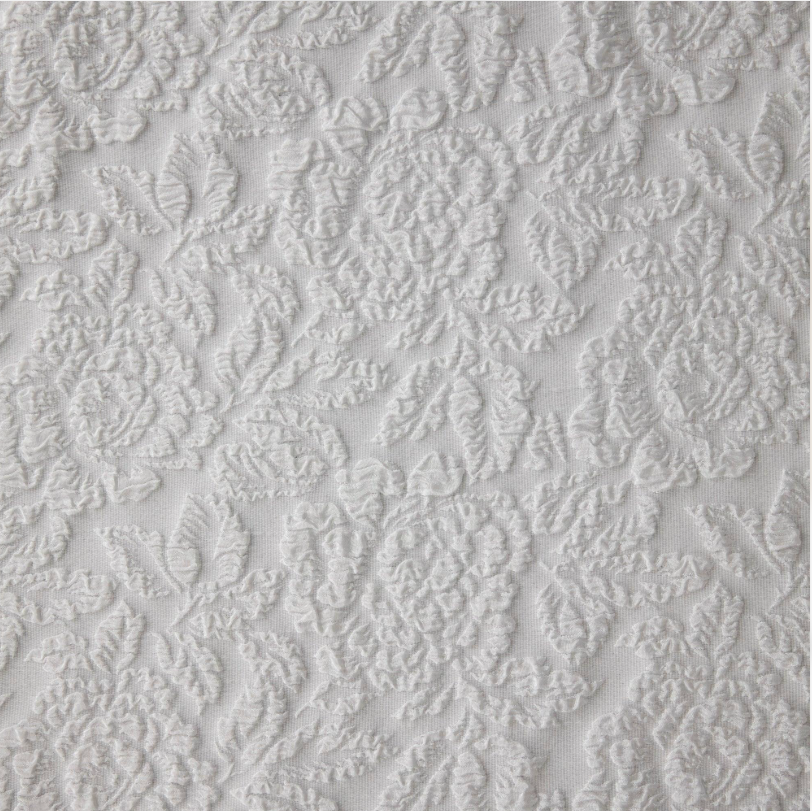
Jacquard Knit is a programmed colour-patterning technique in which different yarn colours are selected across the knitting area to produce a defined design.
The machine controls which needles knit each colour according to the programmed pattern.
The resulting design is integrated into the knitted fabric rather than applied afterwards through printing.
Construction & Variations
Float Jacquard
Float Jacquard is generally produced as a single-jersey construction.
When a particular colour is not selected to form the visible pattern, its yarn travels across the reverse side of the fabric as a float.
This construction can produce a relatively light and flexible fabric compared with some double-bed backing constructions.
Bird's Eye Jacquard
Bird's Eye Jacquard uses a double-bed backing arrangement in which the reverse stitches create a small, scattered pattern resembling bird's-eye dots.
The backing helps manage the yarns that do not form the visible face.
Compared with a long-float construction, it can provide a more contained reverse surface.
Ladder Back Jacquard
Ladder Back Jacquard uses selected backing stitches to manage the yarns on the reverse side.
The backing needles form a ladder-like connection between the knitted areas.
Depending on the needle arrangement, this construction can reduce some of the material used in a more complete double-bed backing.
Yarn and Gauge Considerations
Machine Gauge and Pattern Detail
Machine gauge influences the scale of the stitches and the level of detail that can be reproduced.
Fine-gauge machines can support smaller stitch-based motifs, while coarser gauges are more suitable for larger visual patterns.
However, the final clarity also depends on yarn thickness, stitch density, colour contrast and the dimensions of the pattern repeat.
Yarn Composition and Colour Compatibility
Wool, cotton, viscose and suitable blended yarns can be considered for Jacquard knitwear.
For multi-colour designs, yarns should have compatible characteristics in terms of fibre composition, yarn count, surface appearance and washing behaviour.
Using different fibre types may create differences in shrinkage, colour appearance and surface texture.
Garment Applications
Two-Colour Geometric Jacquard
Two contrasting colours can be arranged into diamonds, squares, zigzags, grids and other repeated geometric patterns.
The pattern can cover the entire garment or be restricted to the chest, sleeves or lower body.
This is suitable for contemporary sweaters, heritage-inspired cardigans and premium casual knitwear.
Placement Jacquard
Jacquard does not need to cover the entire garment.
A pattern can be placed across the chest, shoulders, sleeves, lower body or back.
The main body can remain a solid Single Jersey construction, while a selected area contains the Jacquard design.
Development & Quality Considerations
Excessive Float Length
Long floats on the reverse become exposed, catch during wearing or create uncomfortable areas.
Large spaces between colour changes, unsuitable repeat design or insufficient float management.
Review the colour repeat and backing method. Use an appropriate float-management arrangement where required. Inspect the reverse side and test the fabric for snagging and stretch restriction.
Shrinkage Differences Between Colours
Different colour areas shrink or relax differently, causing the pattern to become distorted.
Different yarn batches, fibre compositions, dyeing conditions and finishing behaviour.
Use compatible yarns and evaluate colour combinations through washing trials. Measure the finished pattern dimensions and check for local distortion after washing.
Selected FAQs
What are the different types of Jacquard Knit?
Common constructions include Float Jacquard, Bird's Eye Jacquard, Stripe Back Jacquard, Twill Back Jacquard and Ladder Back Jacquard. They differ mainly in how inactive yarns are managed and how the reverse side is constructed.
What is the difference between Float Jacquard and Bird's Eye Jacquard?
Float Jacquard generally carries inactive colours across the reverse as floating yarns. Bird's Eye Jacquard uses a double-bed backing arrangement that knits the backing yarns into a small scattered pattern. The two constructions differ in thickness, weight, stretch and reverse-side appearance.
What is the difference between Jacquard and Intarsia?
Jacquard uses selected yarn colours across a programmed pattern, with inactive yarns managed through floats or a knitted backing. Intarsia uses separate yarn supplies for individual colour areas, joining adjacent colour fields without carrying inactive colours across broad areas of the reverse. Jacquard is generally suitable for repeated and distributed patterns, while Intarsia is particularly useful for larger separate colour blocks and placement motifs.
Can Jacquard Knit use two or more colours?
Yes. Jacquard can be developed using two, three or more colours. The practical number depends on the machine, carrier arrangement, backing construction and pattern design. More colours can increase programming complexity, yarn consumption and fabric thickness.
Why are long floats a problem in Jacquard knitwear?
Long floats can catch on jewellery or other objects, reduce local stretch and create an uncomfortable reverse surface. The pattern repeat and backing construction should be developed to manage inactive yarns according to the garment's intended use.
Why does a Jacquard pattern become distorted after washing?
The pattern may change because of yarn relaxation, different shrinkage between colours, backing construction and finishing conditions. Washing trials should be conducted using the intended care process, with pattern dimensions checked before and after washing.
Develop with us
Have a detail
in mind?
Share a reference, a material or an effect you would like to explore. We can help develop a direction for your knitwear.
Discuss Your ProjectExplore our development process ↗