
Case Study CS06 · Knit-to-woven assembly
14GG Knit-and-Woven Hybrid Top Development
Reviewed by VIAKNIT Technical Development Team
Control seam stability and back pleat placement across knit and woven sections.
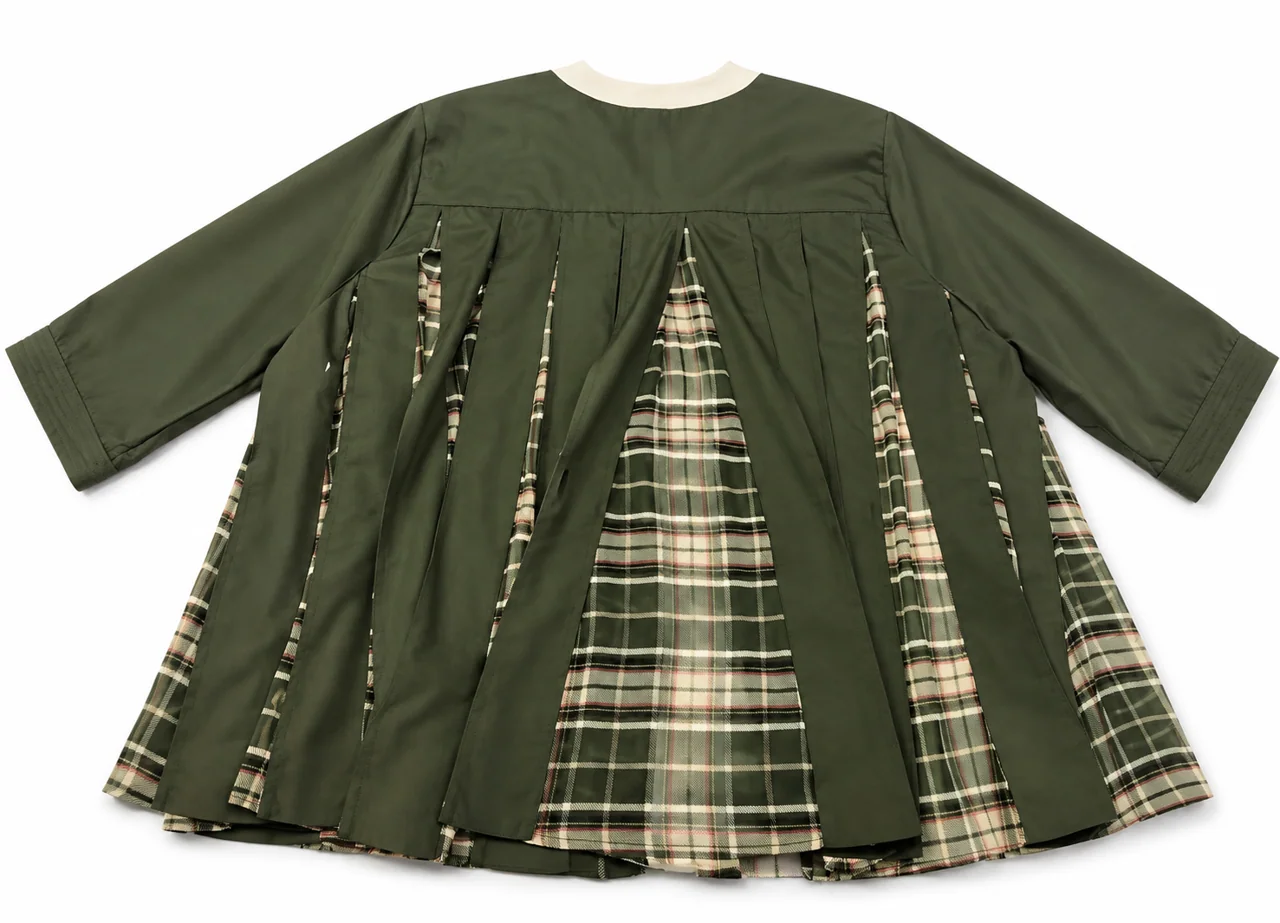
Combining knitted and woven fabrics in one garment creates opportunities for more distinctive silhouettes, textures and construction details. However, the two materials behave differently during knitting, cutting, sewing, relaxation and finishing. Achieving a balanced finished garment requires careful coordination between fabric development, pattern construction and sewing techniques.
This VIAKNIT development case study focuses on a knit and woven combination top developed for an independent design team.
The garment features an ivory knitted front body, olive-green woven sleeves, a woven chest pocket and green-and-beige plaid fabric details. The back construction combines a horizontal yoke with multiple woven pleats, with plaid fabric positioned between the pleated sections to create a layered visual effect when the garment moves naturally.
The knitted body uses 2/68NM Athena yarn, knitted at 14GG in a 1-ply construction.
The main development challenge was not simply producing the knitted and woven components separately. It was making them work together as one garment, while maintaining dimensional consistency, seam stability, accurate pleat positioning and the intended design proportions.
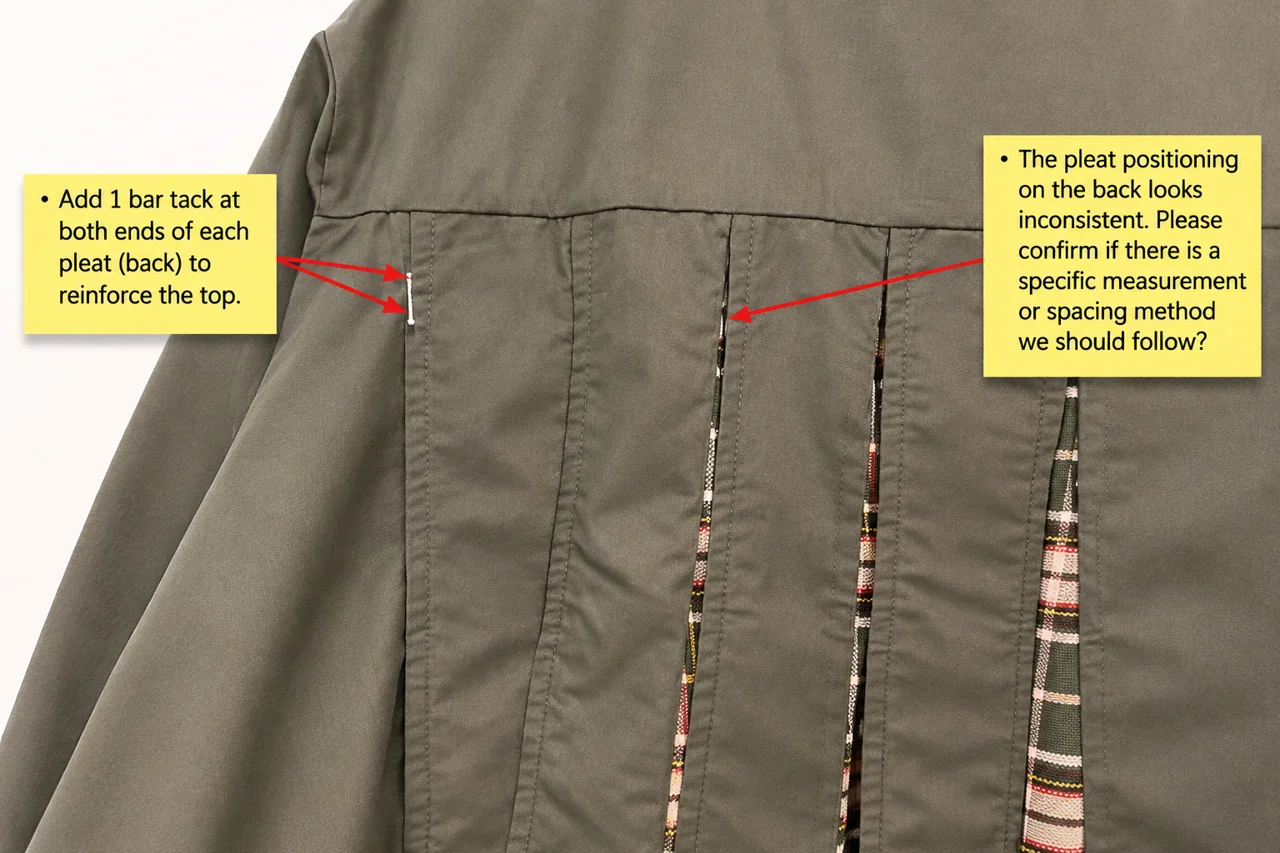
During sample development, the designer also provided specific PP sample comments regarding the spacing of the back pleats and the reinforcement required at their upper ends. These comments became important references for the next stage of technical refinement.
Project Background: Combining Fine-Gauge Knitwear with Woven Construction
This project originated from an independent design team's concept for a garment combining the softness of knitwear with the more structured appearance of woven fabric.
The design required two different material characteristics within one product.
The front body uses ivory knitted fabric to provide a soft and comfortable wearing experience. The sleeves use olive-green woven fabric to create a more defined silhouette.
A woven chest pocket adds another construction element, while green-and-beige plaid fabric is incorporated into the lower section and the back pleated construction.
The back features a horizontal yoke connected to multiple woven pleats. Plaid fabric is positioned between the pleated sections, creating a layered effect that becomes more visible as the garment hangs and moves.
This is not a conventional basic knit top. It is a Knit & Woven Combination Garment in which material contrast and garment construction are central to the design.
For VIAKNIT, the main technical consideration was how to coordinate the different material properties so that the finished garment would maintain its intended appearance and proportions.
Design Requirements and Technical Specifications
Based on the designer's reference images and original technical information, the development requirements were established as follows.
| Specification | Project Details |
|---|---|
| Product | Women's Knit & Woven Combination Top |
| Knitted Yarn | 2/68NM Athena |
| Machine Gauge | 14GG |
| Yarn Construction | 1-ply |
| Front Body | Ivory Knitted Fabric |
| Sleeves | Olive-Green Woven Fabric |
| Chest Detail | Woven Chest Pocket |
| Lower Section | Green and Beige Plaid Woven Fabric |
| Back Construction | Horizontal Yoke with Multiple Woven Pleats |
| Size Range | 34 / 36 / 38 |
The knitted and woven sections require different approaches to material preparation and garment construction.
The knitted front body is made from loop-based fabric, which has a degree of natural elasticity and can change dimensions through relaxation and finishing.
The woven sections have a more stable warp-and-weft structure, but their behaviour still depends on fabric composition, weave, grain direction and any pre-treatment or finishing.
For this reason, the final joining dimensions should not be determined solely from the initial measurements of the two materials.
The knitted fabric needs to be assessed in its relaxed and finished condition, while the woven fabric should be evaluated according to its own preparation and dimensional behaviour.
Six Technical Challenges in Knit & Woven Combination Garment Development
3.1 Managing Different Dimensional Behaviour Between Knitted and Woven Fabrics
The first challenge is the difference in dimensional behaviour between the two materials.
Knitted fabric consists of interconnected loops and has a degree of elasticity. Woven fabric is constructed through interlacing warp and weft yarns and generally has less structural stretch.
If the two materials are joined without evaluating their respective dimensional changes, differences may become visible after finishing or washing.
The knitted section may relax or change dimensions differently from the woven section, potentially resulting in puckering along the seams or an uneven hem.
Our development approach is to evaluate the knitted and woven materials separately before carrying out joining trials.
The dimensional behaviour of each material should be recorded under the relevant relaxation and finishing conditions.
Representative joining samples can then be prepared to assess how the two materials behave together.
The objective is to establish compatible joining dimensions rather than relying only on their original cutting measurements.
3.2 Preventing Puckering and Stretching at Knit-to-Woven Seams
The front body uses 14GG knitted fabric, while the sleeves use woven fabric.
These materials behave differently during sewing, particularly in terms of fabric extension and feeding characteristics.
If the sewing machine feeds the two materials unevenly, the joining area may develop visible waviness. The knitted section may also become stretched during sewing, resulting in uneven sleeve connections or differences between the left and right sides.
Our technical approach focuses on controlling fabric feeding, sewing thread tension and seam construction.
The actual joining method should be evaluated through sample trials using the selected knitted and woven materials.
Particular attention should be given to sleeve symmetry and the appearance of the finished seam.
For fine-gauge knitwear, excessive sewing tension can affect not only the seam but also the surrounding fabric appearance.
The final construction therefore needs to maintain the natural character of the knitted body while providing sufficient stability at the woven connections.
3.3 Maintaining Consistent Spacing and Positioning of the Back Pleats
This was one of the specific issues raised by the designer in the PP Sample Comments.
The customer observed that the back pleats did not appear sufficiently consistent and asked whether the factory could establish a fixed measurement or spacing method.
For a garment with multiple pleated sections, visual consistency depends on accurate positioning rather than simply folding each section by eye.
Our technical approach is to establish a unified positioning reference based on the horizontal back yoke seam.
Each pleat should be positioned according to defined starting points, widths and spacing, following the required left-right symmetry.
A consistent measurement reference or positioning template can then be used during cutting and sewing.
This provides a more repeatable construction method and makes it easier to compare the finished garment with the approved design.
For garments with multiple visible pleats, this type of positioning control is particularly important because small differences can affect the overall visual balance.
3.4 Reinforcing the Upper Ends of the Back Pleats
The designer also requested additional reinforcement at both ends of the back pleats.
The proposed method was Bar Tack reinforcement to help prevent the upper ends of the pleats from gradually opening under wearing tension.
A bar tack is a concentrated reinforcement stitch used to strengthen selected stress points in garment construction.
However, the reinforcement needs to be appropriate for the woven fabric thickness and the intended garment appearance.
If the bar tack is too long, too dense or positioned incorrectly, it may create local puckering or damage the fabric.
The relevant considerations include the reinforcement position, stitch length, stitch count and fabric thickness.
The objective is to secure the upper pleat sections without creating unnecessary stiffness or visible distortion.
The final bar tack specifications should be confirmed through the revised PP sample.
3.5 Preventing Chest Pocket Distortion on the Knitted Front Body
Although the chest pocket is relatively small, its construction can influence the appearance of the knitted front body.
The pocket is made from woven fabric and is attached to a knitted surface with natural elasticity.
If the pocket is sewn directly onto the knitted fabric without controlling the positioning and sewing process, it may cause local stretching, edge waviness or pocket displacement.
Our development approach begins with confirming the pocket dimensions and placement according to the garment measurement chart.
During sewing, fabric feeding and thread tension need to be controlled to minimise distortion.
Depending on the actual fabric behaviour, lightweight stabilising materials or local reinforcement may also be evaluated.
However, reinforcement should not make the knitted front body unnecessarily stiff or compromise its original softness.
The objective is to maintain a clean pocket appearance while allowing the knitted fabric to retain its natural character.
3.6 Coordinating Sleeve Cuffs, Hem Construction and Overall Garment Measurements
The sleeves use woven fabric and require folded edges and stitching details around the cuffs.
The lower section also combines knitted and plaid woven fabric, introducing additional requirements for joining dimensions and pattern direction.
If these components are developed independently without a unified measurement reference, the finished garment may have inconsistent sleeve lengths, uneven hem connections or mismatched plaid directions.
Our approach is to include key dimensions, sewing positions and left-right symmetry requirements within the same technical specification.
Particular attention should be given to sleeve length, cuff construction, hem alignment and the direction of the plaid pattern.
The PP sample provides an opportunity to review these details together before finalising the production specifications.
VIAKNIT's Development Process: From Material Evaluation to PP Sample Refinement
For this type of hybrid garment, development needs to cover both materials and their final construction.
Stage 1 — Knitted Fabric Development
The first stage focuses on the 2/68NM Athena yarn knitted at 14GG in a 1-ply construction.
Representative knitted swatches should be evaluated for stitch density, fabric weight, hand feel and dimensional changes after the relevant finishing process.
The objective is to establish the actual characteristics of the knitted front body before confirming the final joining measurements.
Stage 2 — Woven Fabric and Component Preparation
The woven sleeves, plaid fabric details and chest pocket are reviewed separately.
The development team needs to consider fabric colour, thickness, texture, grain direction and preparation requirements.
The relationship between the olive-green sleeves and the green-and-beige plaid sections should also be considered as part of the overall design.
Stage 3 — First Complete Garment Prototype
The first complete sample brings together the knitted front body, woven sleeves, chest pocket, lower plaid section and back pleated construction.
The main inspection points include the knit-to-woven joining areas, sleeve shape, pocket position and back pleat arrangement.
The overall garment proportions should also be reviewed against the supplied measurement chart.
Stage 4 — PP Sample Comments and Construction Refinement
The designer provided PP Sample Comments on 9 June, specifically identifying inconsistencies in the back pleat spacing and requesting reinforcement at the upper ends of the pleats.
The customer indicated that the other aspects of the garment were generally acceptable, subject to resolving these construction points before considering bulk production.
These comments provided specific technical direction for the next development stage.
The required revisions included establishing a consistent pleat positioning method and evaluating the requested bar tack reinforcement.
The revised PP sample would then need to be reviewed against these requirements before production approval.
Stage 5 — Revised PP Sample Approval
The revised sample should be checked against the designer's comments and the original technical specifications.
The main review points include back pleat spacing, reinforcement position, pocket placement, sleeve symmetry, hem construction and overall garment measurements.
The dimensional behaviour of the assembled knitted and woven sections should also be evaluated under the agreed care and finishing conditions.
Stage 6 — Bulk Production Preparation and Quality Control
Once the revised PP sample has been approved, the confirmed construction details can be transferred into production specifications.
The technical records should include the approved knitted fabric, woven material references, pleat positioning measurements, reinforcement details, pocket placement and garment measurement standards.
These references provide the basis for production preparation and subsequent quality inspection.
The bulk production stage should only be released after the relevant sample and construction approvals have been completed.
VIAKNIT's Key Technical Decisions
The most important decision in this project was not to introduce additional complexity, but to control the relationship between the different materials.
Maintaining the Softness of the 14GG Knitted Front Body
The knitted front body uses 2/68NM Athena yarn at 14GG in a 1-ply construction.
The fabric needs to retain its fine surface appearance and soft hand feel while providing sufficient stability for the woven components attached to it.
Its final dimensions should be assessed after appropriate relaxation and finishing.
Preserving the Structure of the Woven Sleeves
The woven sleeves provide a more defined silhouette than the knitted front body.
Their construction needs to account for fabric grain direction, cutting accuracy, sewing stability and sleeve symmetry.
The joining method should avoid unnecessary tension on the knitted body.
Establishing a Consistent Back Pleat Positioning Reference
The back pleats are an important visual feature of this design.
Rather than relying on individual sewing judgement, a consistent positioning template should be established using the back yoke seam as the main reference.
This makes the pleat spacing and left-right arrangement easier to control.
Using Bar Tack Reinforcement at Selected Stress Points
The requested bar tack reinforcement addresses a specific construction concern at the upper ends of the back pleats.
Its position and stitching specifications need to be confirmed according to the actual woven fabric thickness and garment construction.
The reinforcement should provide adequate support without creating unnecessary local stiffness or puckering.
Coordinating the Two Materials Before Finalising Garment Dimensions
The knitted and woven components should be evaluated separately before their final joining dimensions are confirmed.
This is particularly important for the hem and other areas where both materials meet.
The final garment specifications should reflect the actual behaviour of the prepared materials rather than their initial unprocessed measurements.
Development Results and Production Approval Requirements
The main value of this project is the development of a designer garment combining 14GG fine-gauge knitwear with woven construction.
The original technical information and customer feedback provide a clear record of the design requirements and the construction issues identified during sample review.
The available project documentation confirms that the designer specifically requested improvements to the back pleat spacing and upper-end reinforcement.
However, the available records do not establish that these revisions were completed, that the revised PP sample received final approval or that bulk production was released.
For this reason, the project should be presented as a Sample Development & Production Preparation Case Study.
Before bulk production, the following items require confirmation.
| Verification Area | Required Confirmation |
|---|---|
| Knitted Fabric | 2/68NM Athena, 14GG, 1-ply |
| Material Compatibility | Dimensional behaviour of knitted and woven sections |
| Joining Seams | No unacceptable puckering or distortion |
| Back Pleat Spacing | Consistent positioning according to the approved reference |
| Bar Tack Reinforcement | Approved position and construction |
| Chest Pocket | Correct placement and stable attachment |
| Sleeve Symmetry | Consistent left and right construction |
| Hem Construction | Even joining and correct plaid direction |
| Garment Measurements | Compliance with the approved size specifications |
| Washing Assessment | Dimensional behaviour of the assembled garment |
For hybrid garments, checking the two materials separately is not sufficient.
The complete garment should also be evaluated because the joining seams, pleats and pocket construction can influence the behaviour of the assembled product.
This distinction is important when moving from sample development to bulk production approval.
What Designers Should Consider Before Developing Knit & Woven Combination Garments
A successful knit and woven hybrid garment requires early coordination between material selection and garment construction.
Before starting development, designers should consider the knitted yarn, machine gauge, woven fabric type, fabric thickness, garment measurements and intended joining methods.
The relationship between the two materials should be reviewed before the complete garment is sampled.
For designs involving woven sleeves, chest pockets or pleated back panels, it is particularly important to establish the construction details and positioning references in advance.
Designers should also consider how the garment will behave after finishing and washing. Different materials may respond differently, even when they are combined within the same garment.
If a complete Tech Pack is not available, reference images and preliminary measurements can provide a starting point for a technical review.
For more complex designs, representative joining samples and construction trials can help establish a practical development direction before the complete PP sample is prepared.
Technical Questions
How do you control shrinkage differences between knitted and woven materials?
Both materials should be assessed separately under the relevant preparation, finishing and care conditions.
Their dimensional changes can then be compared before establishing the final joining measurements.
The assembled garment should also be evaluated after the agreed washing or care process because the interaction between the materials may produce different results from those observed in separate fabric tests.
How do you prevent puckering at the knit-to-woven joining points?
Puckering can occur when the knitted and woven fabrics feed differently during sewing or when excessive tension is applied to one material.
The main considerations include fabric feeding, sewing thread tension, seam construction and the dimensional behaviour of the materials.
Practical sample trials using the actual fabrics provide a more reliable basis for confirming the joining method.
What tests should be completed before bulk production of hybrid garments?
The relevant checks depend on the materials and garment construction.
For knit and woven combination garments, important evaluations include dimensional changes of both materials, joining seam appearance, puckering, garment measurements and the stability of special construction details.
Pleat positioning, bar tack reinforcement, pocket attachment and sleeve symmetry should also be checked against the approved PP sample.
The complete assembled garment should be evaluated under the agreed care and finishing conditions before bulk production approval.
Related Expertise
7GG Hybrid Down Knit Cardigan Development ↗
Discuss Your Project