Tuck Stitch & Waffle Knit
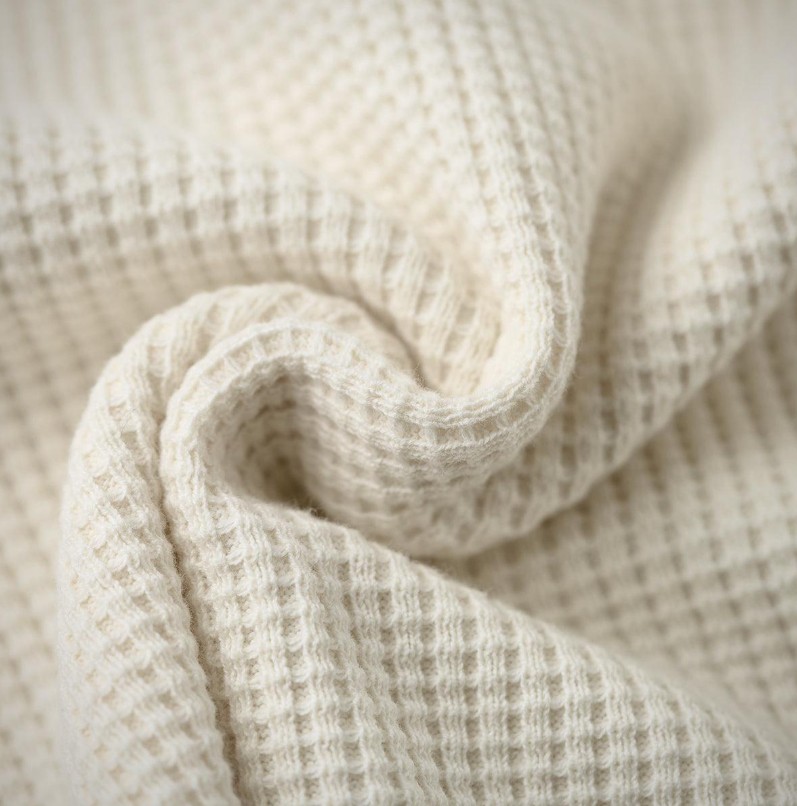
Held loops build raised cells and recessed channels.
Technical Overview
Tuck stitch is formed when a knitting needle receives a new yarn but does not immediately knock over the existing loop.
The new yarn is held together with the previous loop until a later knitting action completes the stitch.
This creates a different loop arrangement from conventional knit stitch.
Construction & Variations
Basic Tuck Stitch
Basic Tuck Stitch uses selected needles to hold additional yarn while neighbouring needles continue forming normal knit stitches.
This creates local yarn accumulation and changes the surface appearance.
The effect can be relatively subtle or more pronounced depending on the number of tuck positions and the frequency of the repeat.
Waffle Knit
Waffle Knit is a family of textured constructions that create a grid-like surface with raised blocks and recessed channels.
The effect resembles the surface of a traditional waffle, which is why the structure is commonly known by this name.
Many waffle constructions use repeated tuck arrangements to create the raised and recessed areas.
Large-Cell Waffle
Large-cell Waffle Knit uses a wider structural repeat to create more pronounced geometric blocks.
The fabric has a stronger surface character and can be used as a main design feature rather than simply a background texture.
It is suitable for relaxed sweaters, cardigans, loungewear and textured outerwear.
Yarn and Gauge Considerations
Machine Gauge
Machine gauge determines the needle spacing and influences the range of yarns and stitch constructions that can be developed.
A finer gauge can support smaller and more delicate tuck patterns, while a coarser construction can create more pronounced surface texture.
However, cell size is also determined by the needle selection, number of courses in the repeat and yarn characteristics.
Yarn Composition and Yarn Count
Wool, cotton, viscose and suitable blended yarns can be considered for tuck-based structures.
Wool blends may be suitable for sweaters and winter knitwear where a fuller surface and softer hand are required.
Cotton and cotton blends can be explored for summer waffle garments, although the yarn specification and finishing process must be considered carefully.
Garment Applications
Fine Waffle for Lightweight Summer Knitwear
A fine waffle construction can be used for lightweight sweaters, short-sleeved tops and summer cardigans.
Small raised cells create texture while keeping the overall appearance relatively restrained.
This is particularly suitable for cream, ivory, oatmeal and light beige colour palettes, where the surface becomes visible through natural light and shadow.
Large Waffle for Textured Sweaters
Larger waffle structures can be used as the main construction of a sweater.
The raised blocks and recessed channels create a strong visual identity without requiring additional embroidery or jacquard.
This approach works well for relaxed-fit sweaters, contemporary casualwear and textured winter knitwear.
Development & Quality Considerations
Excessive Fabric Contraction
The fabric becomes narrower or shorter after relaxation or washing, causing garment measurements to fall outside the approved specification.
Tuck-loop accumulation, yarn relaxation, stitch length and the positioning of tuck stitches within the repeat.
Measure fabric dimensions immediately after knitting and after relaxation. Conduct washing trials using the intended care conditions. Establish finished garment measurements from the approved washed fabric.
Loss of Waffle Definition After Washing
The raised cells become flatter and the recessed channels lose their definition.
Excessive mechanical action, unsuitable finishing conditions, high pressing pressure or changes in yarn relaxation.
Compare the fabric before and after washing. Adjust the washing and finishing process according to the yarn and construction. Avoid excessive pressure during pressing and use the approved finished sample as the production reference.
Selected FAQs
What is Waffle Knit?
Waffle Knit is a family of textured knitted constructions that create raised blocks and recessed channels in a grid-like pattern. Many waffle structures use repeated tuck arrangements to produce their characteristic three-dimensional surface.
What is the difference between Tuck Stitch and Waffle Knit?
Tuck Stitch is a basic stitch-forming technique, while Waffle Knit is a fabric structure or visual effect that can be developed using repeated tuck arrangements. Not every tuck fabric is a waffle structure.
What is the difference between small-cell and large-cell Waffle Knit?
Small-cell waffle has a finer and more closely spaced texture, making it suitable for lightweight knitwear and subtle surface effects. Large-cell waffle creates more pronounced raised blocks and recessed channels, making it suitable for textured sweaters, cardigans and heavier casualwear.
How can Waffle Knit be used in designer sweaters?
Waffle Knit can be used as the main garment structure, as a selected panel or in combination with Single Jersey, Rib or Cable Knit. Designers can also change cell size, direction and placement to create a more individual surface design.
Why does Waffle Knit shrink after washing?
Tuck-loop accumulation, yarn relaxation, stitch length, fibre composition and finishing conditions can all influence dimensional changes. Width and length should be measured before and after washing, using the intended care process.
How can manufacturers prevent Waffle Knit from losing its texture?
Manufacturers should control tuck frequency, stitch settings, yarn feeding and finishing conditions. Excessive pressing and unsuitable mechanical washing may flatten the raised areas. The approved washed sample should be used as the bulk production reference.
Develop with us
Have a detail
in mind?
Share a reference, a material or an effect you would like to explore. We can help develop a direction for your knitwear.
Discuss Your ProjectExplore our development process ↗