Knitted Piqué
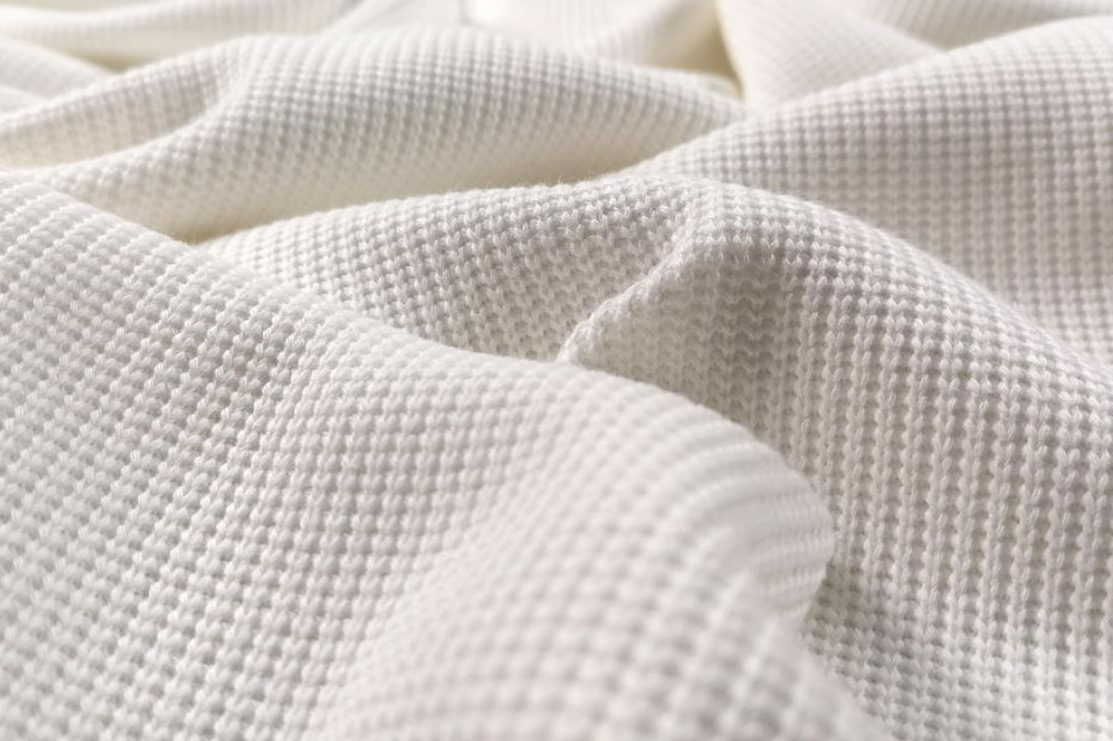
Knit and tuck stitches form a textured cellular surface.
Technical Overview
Knitted Piqué is a family of textured knitting constructions that use tuck stitches to create raised and recessed areas on the fabric surface.
In a conventional knit stitch, the new yarn is pulled through the existing loop to form a new knitted loop.
In a tuck stitch, the needle receives the new yarn without immediately knocking over the previous loop. The held loop and the tuck yarn remain together until a subsequent knitting action completes the stitch formation.
Construction & Variations
Single Piqué
Single Piqué is one of the common basic piqué constructions.
It combines plain knit courses with selected tuck stitches arranged in a repeating sequence. The tuck positions create a relatively fine and regular surface texture.
Depending on the construction, the face may show small raised cells while the reverse has a different loop arrangement.
Double Piqué
Double Piqué uses a different and generally more involved tuck arrangement than basic Single Piqué.
Depending on the specific construction, the tuck loops are accumulated in a different sequence, producing a more pronounced surface and a different fabric thickness.
The resulting fabric can have greater body and a more noticeable textured appearance.
Honeycomb Piqué
Honeycomb Piqué creates a cellular surface with alternating raised and recessed areas.
The pattern resembles a small honeycomb grid and gives the fabric a more pronounced three-dimensional appearance.
Depending on the construction, honeycomb effects may be developed through tuck arrangements on selected needles and courses.
Yarn and Gauge Considerations
Machine Gauge and Piqué Scale
Machine gauge influences the needle spacing and the level of stitch fineness that can be developed.
A finer gauge can support smaller and more delicate surface patterns, while a coarser construction can create more pronounced texture.
However, cell size is not determined by gauge alone. Needle selection, tuck distribution and the number of courses in the repeat are equally important.
Yarn Composition and Yarn Count
Cotton and cotton blends are common choices for traditional piqué applications.
Depending on the product, wool blends, viscose blends and suitable synthetic yarns can also be explored.
Cotton can provide a natural hand feel and is commonly used for polo-inspired garments. Viscose can introduce softness and drape, while blended yarns may offer different performance characteristics.
Garment Applications
Fine Piqué for Refined Polo Shirts
A fine piqué structure can be used to develop a more understated interpretation of the classic polo shirt.
Compared with a smooth jersey surface, the small raised texture adds visual depth without requiring additional colour or decoration.
This direction is suitable for premium casualwear, golf-inspired collections and modern business-casual garments.
Micro Piqué for Minimalist Designer Collections
Micro Piqué offers a way to introduce texture into garments without making the surface visually heavy.
It is suitable for fine-gauge summer knitwear, minimalist polo sweaters and lightweight layering pieces.
A tonal colour palette can emphasise the surface pattern through light and shadow rather than strong colour contrast.
Development & Quality Considerations
Uneven Piqué Cells
The honeycomb or geometric cells appear irregular, with differences in size, depth or spacing across the fabric.
Uneven yarn feeding, inconsistent tuck formation, machine condition and differences in loop accumulation.
Check needle selection and the knitting programme before production. Maintain consistent yarn feeding and stitch settings. Inspect the surface across the full fabric width rather than checking only one small area.
Loss of Surface Definition After Washing
The raised piqué texture becomes flatter or less distinct after washing and finishing.
Unsuitable washing conditions, mechanical pressure, excessive finishing tension and changes in yarn relaxation.
Evaluate the surface before and after the intended washing process. Select finishing conditions according to the yarn composition and construction. Avoid excessive pressure that may flatten the raised areas.
Selected FAQs
What are the different types of Piqué knit?
Common constructions include Single Piqué, Double Piqué, Honeycomb Piqué, Birdseye Piqué, Cross-Tuck Piqué and Micro Piqué. Their surface appearance and fabric properties depend on the stitch arrangement, tuck distribution, yarn and knitting settings. Terminology can vary between manufacturers, so the actual structure should be confirmed through a technical sample.
What is the difference between Single Piqué and Double Piqué?
Single Piqué and Double Piqué use different stitch repeats and tuck arrangements. Double Piqué generally produces a more pronounced or substantial structure, depending on the construction. The exact differences in thickness, weight and flexibility should be assessed through physical swatches rather than assumed from the names alone.
What is the difference between Piqué and Single Jersey?
Single Jersey has a relatively smooth face and is formed mainly through plain knit stitches. Piqué introduces tuck stitches to create a raised and recessed surface. This changes the fabric texture, thickness, width behaviour and wearing characteristics.
Can Piqué be used for garments other than polo shirts?
Yes. Piqué can be developed for lightweight sweaters, summer tops, knitted dresses, cardigans and contemporary casualwear. Fine Piqué is suitable for more understated garments, while Honeycomb and other textured constructions can create a stronger design feature.
Why does Piqué fabric shrink or lose its texture after washing?
Dimensional changes can result from fibre relaxation, tuck-loop accumulation, stitch length and finishing conditions. Surface flattening may also occur when unsuitable mechanical or thermal finishing is applied. Washing trials should be carried out using the intended care conditions before bulk approval.
How can manufacturers maintain consistent Piqué texture during production?
Manufacturers should control needle selection, tuck arrangement, yarn feeding, stitch settings and machine condition. The size and depth of the surface cells should be inspected across the full fabric width. Washing and finishing trials are also necessary to confirm that the approved texture remains consistent.
Develop with us
Have a detail
in mind?
Share a reference, a material or an effect you would like to explore. We can help develop a direction for your knitwear.
Discuss Your ProjectExplore our development process ↗