Cable Knit
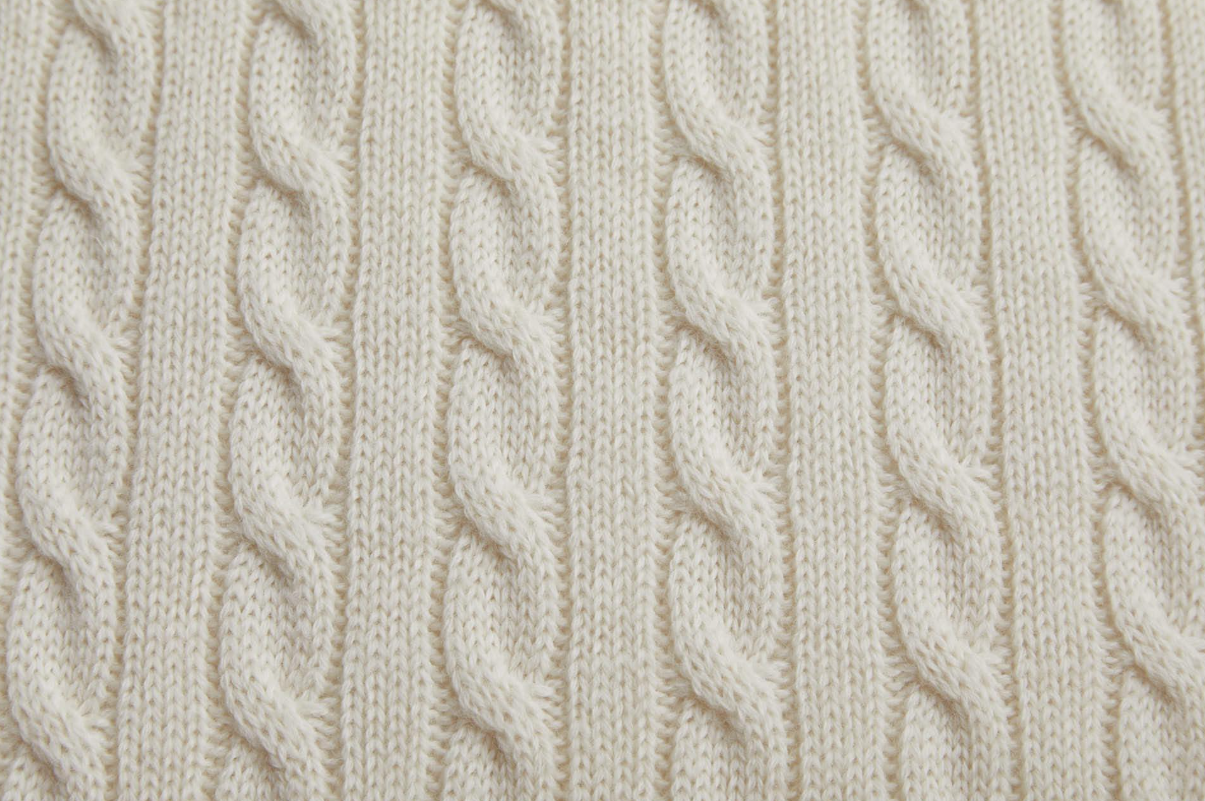
Crossed stitch groups form raised ropes and geometric relief.
Technical Overview
Cable Knit is created by changing the normal order of selected stitches.
In a conventional knitted fabric, stitches remain in their original vertical sequence. In a cable structure, groups of stitches are transferred and crossed so that one group passes in front of or behind another.
This crossing creates the characteristic raised and twisted appearance.
Construction & Variations
Basic 2×2 Cable
A 2×2 cable crosses two stitches over an adjacent group of two stitches.
It creates a relatively compact rope-like pattern and is a practical starting point for cable development.
The smaller crossing scale is suitable for everyday sweaters, cardigans, sleeve details and fine decorative panels.
Rope Cable
Rope Cable creates a continuous twisted appearance through repeated crossings.
The crossings can be arranged in a regular sequence to produce a consistent rope-like column.
It is a classic choice for Aran-inspired sweaters, cable cardigans and winter accessories.
Diamond Cable
Diamond Cable combines crossing groups to create enclosed diamond-shaped patterns.
The design can use a single diamond, repeated diamonds or multiple sizes arranged across the garment.
It is widely associated with traditional textured knitwear but can also be developed into more restrained geometric patterns for modern collections.
Yarn and Gauge Considerations
Machine Gauge and Cable Scale
Machine gauge influences needle spacing and the scale of the knitted structure.
Coarser gauges can be suitable for larger and more pronounced cables, while finer gauges can be used for smaller and more restrained cable patterns.
However, cable scale is not determined by gauge alone. The number of stitches crossed, the crossing frequency, yarn diameter and stitch length all influence the result.
Yarn Composition and Flexibility
Yarn must be able to tolerate the movement and tension involved in stitch transfer.
Wool and suitable wool blends are commonly explored for cable knitwear because their flexibility can support the formation of crossed stitch structures.
Cotton, viscose blends and other fibres can also be evaluated, but their suitability depends on yarn construction, strength, flexibility and the complexity of the transfer.
Garment Applications
Mixed Cable Widths
Different cable widths can be combined within one garment.
For example, a wide 4×4 cable can form the central design feature, while smaller 2×2 cables are positioned on either side.
The contrast creates a clear hierarchy between the main motif and supporting details.
Localised Cable Placement
Cable structures can be positioned selectively rather than covering the entire garment.
Examples include a single cable along the shoulder, a central cable on the front body, cable details around pockets or a narrow cable column running along the sleeve.
This approach allows a designer to introduce a recognisable texture while keeping the garment relatively lightweight and visually restrained.
Development & Quality Considerations
Cable Panel Width Contraction
The cable panel finishes narrower than expected, causing the garment to become smaller or the cable area to pull inward.
Crossed stitches draw the fabric inward. The amount of contraction depends on the number of stitches crossed, cable frequency, yarn, gauge and stitch settings.
Measure the cable panel after relaxation rather than relying only on the programmed stitch count. Adjust the panel width or stitch arrangement according to the approved sample. Confirm the finished dimensions after washing.
Dropped Stitches and Yarn Breakage During Transfer
Stitches are lost or the yarn breaks around the crossing point, leaving holes or damaged sections.
Excessive tension during transfer, insufficient yarn flexibility, unsuitable yarn strength or machine transfer limitations.
Evaluate yarn suitability before approving the structure. Review the transfer sequence and avoid unnecessarily complex crossings. Inspect the first knitted panel carefully before continuing production.
Selected FAQs
What are the different types of Cable Knit?
Common variations include 2×2, 3×3 and 4×4 cables, Single Cable, Double Cable, Rope Cable, Travelling Cable and Diamond Cable. Mock Cable is another related design approach that creates a cable-inspired appearance through alternative stitch arrangements.
What is the difference between 2×2, 3×3 and 4×4 Cable Knit?
The numbers describe the groups of stitches involved in the crossing. A 2×2 cable crosses two stitches over another two, while 3×3 and 4×4 involve larger groups. The larger crossing generally creates a wider and more pronounced cable, although the final appearance also depends on gauge and yarn.
What is the difference between Rope Cable and Diamond Cable?
Rope Cable forms repeated twisted columns that resemble a continuous rope. Diamond Cable combines crossing groups to create enclosed diamond-shaped patterns. Both can be developed in different scales and combined with other textured structures.
Can Cable Knit be produced on computerized flat knitting machines?
Yes. Computerized flat knitting machines can produce many cable designs through programmed stitch transfer. However, the actual construction depends on the machine's transfer capability, gauge, needle-bed arrangement, yarn and knitting programme. Not every hand-knitted cable pattern can be transferred directly into machine production.
Why does Cable Knit fabric become narrower than plain jersey?
Crossing groups of stitches pulls the fabric inward around the cable area. This draw-in can make a cable panel narrower than a plain jersey panel with a similar stitch count. The actual contraction depends on the cable arrangement, crossing frequency, yarn, gauge and finishing.
How can manufacturers prevent cable patterns from becoming uneven?
Manufacturers should control the transfer programme, stitch count, yarn feeding, crossing direction and panel dimensions. The cable pattern should be checked during knitting and again after finishing. Reference points should also be established for pattern alignment during linking and assembly.
Develop with us
Have a detail
in mind?
Share a reference, a material or an effect you would like to explore. We can help develop a direction for your knitwear.
Discuss Your ProjectExplore our development process ↗